CARBON REDUCTION PLAN
Forward Community Care Ltd. is dedicated to achieving Net Zero carbon emissions by 2050, supported by a detailed baseline emissions analysis and carefully designed reduction strategies. In line with the Greenhouse Gas Protocol Corporate Accounting and Reporting Standard, we systematically measure and manage emissions across Scope 1, Scope 2, and Scope 3, ensuring transparency and consistency in our reporting.
Our baseline year, 2020, incorporates data on energy consumption, waste disposal, and travel for business purposes. To achieve our Net Zero target, we have established bold reduction goals: an 80% reduction in Scope 1 emissions, 30% in Scope 2 emissions, and 20% in Scope 3 emissions by 2050, equating to an overall reduction of 79.9%. By 2050, we anticipate our carbon emissions will decrease to 223.25 tCO2e, aligning with our reduction trajectory over the next five years.
Our strategy incorporates measures such as transitioning to an electric vehicle fleet, improving energy efficiency, minimising waste, fostering employee participation, and prioritising sustainable procurement. The use of Carbon Trust Footprint Manager and Tableau allows us to meticulously monitor and analyse emissions data, ensuring continuous progress and reliable reporting.
We remain committed to maintaining the highest service standards while working to minimise our environmental impact. This Carbon Reduction Plan provides an overview of our 2023 baseline emissions and outlines our strategic pathway to achieving progressive and measurable reductions in carbon emissions.
Company Overview
Name: FORWARD COMMUNITY CARE LTD
Location: Tudor Leaf Business Park,Unit 230a, 2-8 Fountayne Road, London, England, N15 4QL
Founded: 28 April 2020
To set a foundation for our Carbon Reduction Plan, we have conducted an emissions inventory for the year 2020. This includes all relevant sources of greenhouse gas emissions from our operations.
Scope 1: Direct Emissions
Office Heating: Use of natural gas and any other fuels for heating our various office locations.
Company Vehicles: Emissions from any company-owned vehicles used for service provision and staff travel.
Scope 2: Indirect Emissions
Electricity Consumption: Emissions from the electricity used in our offices, Temporary Accommodations, and other facilities.
Scope 3: Other Indirect Emissions
Purchased Goods and Services: Emissions from the production and transportation of medical supplies, office materials, and other goods we use.
Business Travel: Emissions from staff travel using public transportation or personal vehicles for business purposes.
Employee Commuting: Emissions from staff commuting to and from work.
Waste Generation: Emissions from waste produced in our operations and its disposal.
Strategies for Emission Reduction
We will apply the following strategies across our operations to reduce CO2 emissions:
Sustainable Transport and Fleet Management: We will continue transitioning our fleet to electric vehicles (EVs), and all business-related travel will be optimised using route-planning tools, Roundys and Route4Me to reduce unnecessary mileage. During periods of high demand, we will use Geotab to monitor fleet performance, ensuring efficiency and optimising route management. By 2028, 100% of our fleet will be electric, reducing Scope 1 emissions by 80%. We are committed to achieving internationally recognised environmental management certifications such as ISO14001 or PAS 2060 as part of our long-term sustainability strategy.
Energy-Efficient Service Delivery: We will adopt energy-efficient technologies in our operations. For example, LED lighting, smart HVAC systems, and renewable energy sources will be used across service delivery areas. These systems are integrated into our operations, and energy consumption will be tracked using Sphera to monitor performance and adjust energy-saving measures.
Waste Reduction and Circular Economy: We will implement zero-waste strategy that includes minimising use of single-use plastics and prioritising recycling. We will also encourage circular economy principles by collaborating with suppliers who offer reusable, recyclable, or biodegradable materials. These efforts will be monitored through EcoVadis, ensuring compliance with environmental standards.
Sustainable Procurement: We will source goods and services from suppliers with certified environmental management systems, prioritising products and EcoVadis will be used to track supplier sustainability.
Waste Reduction and Recycling Initiatives: We have initiated a phased approach to eliminate single-use plastics across all our operations. This includes replacing plastic water bottles with refillable alternatives, introducing compostable packaging in service delivery, and switching to durable, reusable materials for office supplies and service equipment.To maximise recycling efficiency, we have implemented a robust waste segregation system at every site, ensuring that all recyclable materials, such as paper, cardboard, plastics, and metals—are processed appropriately. We collaborate with certified recycling partners to maintain a zero-to-landfill policy for non-hazardous waste.
Sustainable Procurement Practices: By sourcing materials and products from local suppliers within a defined radius, we significantly reduce transportation-related emissions. This approach also supports local economies and minimises lead times.All cleaning agents and consumables procured for service delivery are biodegradable and environmentally friendly. Additionally, all office and administrative paper products are certified by the Forest Stewardship Council (FSC) or equivalent organisations.
Water Conservation: Low-flow taps and dual-flush toilet systems have been installed across all facilities to minimise water wastage. Water meters are used to track consumption, enabling us to identify inefficiencies and take corrective action promptly.We have installed rainwater collection systems at suitable locations for use in irrigation, vehicle cleaning, and other non-potable applications, ensuring optimal utilisation of natural resources.
Renewable Energy Integration: We are investing in renewable energy technologies, including solar panels and wind turbines, to power our facilities. These installations are monitored for efficiency and contribute to reducing reliance on non-renewable energy sources. All purchased electricity is sourced exclusively from suppliers offering 100% renewable energy, verified through certifications such as Renewable Energy Guarantees of Origin (REGO).
Biodiversity Enhancement: At our operational sites, we are developing pollinator-friendly gardens and planting native trees to support local biodiversity. These efforts contribute to improving air quality and providing habitats for local wildlife.We actively participate in reforestation initiatives and collaborate with community organisations to support wildlife corridors and other biodiversity-focused projects.
Sustainable Packaging: Packaging used in all our operations is being replaced with fully biodegradable or recyclable materials. This includes introducing paper-based alternatives for all plastic-based consumables.We work closely with suppliers to minimise excessive packaging and advocate for sustainable practices throughout the supply chain.
Digitalisation and Paperless Systems: Digital tools are fully integrated into our operations, eliminating the need for paper-based records, or communications. This includes implementing secure cloud-based systems for data storage and sharing.We exclusively use electronic invoicing and communication to reduce resource consumption and improve operational efficiency.
Climate-Resilient Operations: A comprehensive assessment of climate-related risks, such as flooding and extreme heat, has been carried out for all operational sites. Mitigation measures include infrastructure enhancements and contingency plans to ensure uninterrupted service delivery.For any new builds or renovations, we use materials and construction techniques designed to reduce carbon footprints, such as low-emission concrete and insulated building envelopes.
Measuring and Reporting Progress
To ensure we meet carbon neutrality target by 2050, we measure and report our progress regularly using the following methods:
Carbon Footprint Tracking: We track our Scope 1, 2, and 3 emissions using Sphera and Net Zero Cloud, which allows us to monitor reductions in emissions from transportation, energy use, waste, and procurement. This software provides real-time reporting, enabling us to make adjustments quickly if necessary. Monthly and quarterly emissions reports are generated to ensure transparency and accountability.
Key Performance Indicators (KPIs): We have set and are tracking specific KPIs such as:
Percentage of electric vehicles in the fleet.
Energy consumption per service delivery.
Reduction in carbon emissions from waste management and recycling.
Supplier sustainability performance.
These KPIs are tracked and updated regularly through Tableau, which provides visual reports for internal and external stakeholders.
Communication and Evidence of Success
We ensure our progress toward carbon neutrality is communicated effectively to the Authority and all stakeholders:
Quarterly Reports: We provide detailed quarterly sustainability reports, including emissions reductions, energy savings, waste management success, and progress on fleet electrification. These reports include data visualisations from Tableau to track and present performance against targets.
Sustainability Dashboard: A real-time sustainability dashboard will be developed using Tableau and Microsoft Power BI, providing clear visual insights into our emissions data and operational performance. The dashboard will be updated regularly and accessible to key stakeholders for transparency.
Third-Party Audits: To validate our carbon reduction claims, we will undergo third-party audits conducted by EcoAct and Carbon Trust, providing independent verification of our progress. These audits will be incorporated into our quarterly and annual reports, providing further credibility to our sustainability efforts.
Continuous Improvement: Based on feedback from the Authority, we will continuously refine our sustainability practices. This will include regular feedback loops via SurveyMonkey.
Measures to Minimise CO2 Impact of Our Vehicle Fleet and Track Impact
Fleet Electrification and Transition Targets
We have established clear targets to minimise CO2 impact of our vehicle fleet:
Transition 70% of the fleet to electric vehicles (EVs) by 2026, reaching 100% by 2028.
Reduce fleet-related Scope 1 emissions by 50% by 2025 and 80% by 2035.
To date, we have transitioned 50% of our fleet to EVs, achieving a 30% reduction in fleet emissions. We have installed EV charging stations at all operational hubs, ensuring the infrastructure supports this transition. Charging is managed using ChargePoint to optimise charging times and energy efficiency, reducing grid strain and maximising renewable energy usage.
Route Optimisation and Tracking
We use Digital tools likeRoute4Me, and Telematics Fleet Management Systems (e.g., Geotab) to optimise routes, reducing unnecessary mileage by up to 20%. These systems provide real-time tracking of vehicle locations and fuel consumption, allowing us to minimise idle time and ensure the most efficient routing. Additionally, we monitor fleet emissions monthly using Sphera’s Carbon Tracking System, enabling transparent reporting and timely adjustments.
Eco-Driving Initiatives
To further reduce CO2 emissions, we implement eco-driving training through GreenRoad. This initiative has improved fuel efficiency across our fleet by 15%, with telematics monitoring driver behaviour and providing feedback to encourage efficient driving practices.
Alternative Transport and Employee Engagement
We actively encourage alternative, low-carbon transport options through initiatives like the Cycle-to-Work Scheme, which has led to 10% reduction in staff reliance on personal vehicles. Public transport passes are subsidised for employees, and virtual meeting tools such as Microsoft Teams reduce unnecessary travel.
Collaborating with 3rd Party Logistics Providers
For third-party logistics, we prioritise partnerships with providers that operate EV fleets or hybrid vehicles. Contracts include sustainability clauses mandating regular emissions reporting and adherence to carbon reduction goals.
Technology Used to Track and Reduce CO2 Emissions
ChargePoint: For EV charging infrastructure management.
Telematics Platforms (e.g., Geotab, GreenRoad): For route optimisation, fuel tracking, and eco-driving monitoring.
Roundys: For staff scheduling and route planning, minimising unnecessary trips.
Sphera Carbon Tracking System: For monthly monitoring of fleet emissions and alignment with reduction targets.
Evidence of Success and Continuous Improvement
Achieved a 30% reduction in fleet CO2 emissions through electrification and optimised route planning.
Reduced mileage by 20% using route optimisation tools.
Improved fuel efficiency by 15% via eco-driving training programs.
We will continue to report fleet emissions monthly and share progress with stakeholders using visual dashboards in Tableau.
Completed Carbon Reduction Initiatives
We have successfully implemented several key initiatives to reduce our carbon emissions, demonstrating our commitment to environmental sustainability and our path towards achieving Net Zero emissions.
Fleet Electrification:
Transitioned 50% of our company vehicle fleet to electric vehicles, significantly reducing Scope 1 emissions.
Installed electric vehicle charging stations at all company premises to encourage employee adoption of electric vehicles.
Energy Efficiency Enhancements:
Upgraded lighting systems to LED technology, resulting in a 20% reduction in energy consumption for lighting.
Implemented a smart heating, ventilation, and air conditioning (HVAC) system that adapts to occupancy and weather, achieving a 15% reduction in heating and cooling energy usage.
Waste Reduction and Recycling:
Introduced comprehensive recycling schemes across all operations, decreasing landfill waste by 40%.
Initiated a company-wide zero-waste program, including the reduction of single-use plastics and promotion of reusable materials.
Employee Engagement and Training:
Launched an employee sustainability awareness program that educates staff on best practices for energy conservation, waste reduction, and sustainable commuting.
Promoted a ‘cycle to work’ scheme that incentivises employees to reduce their carbon footprint associated with commuting.
Sustainable Procurement:
Revised procurement policies to favour suppliers with certified environmental management systems and those who demonstrate a commitment to carbon reduction.
Engaged in long-term contracts with suppliers that provide products with a lower carbon footprint, such as sustainably sourced goods.
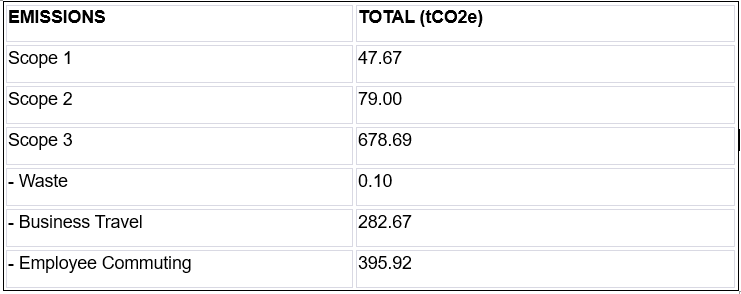
Baseline Year Emissions:
Note: Upstream and Downstream Transportation & Distribution are not relevant to FORWARD COMMUNITY CARE LTD.
Total Emissions: 805.36 tCO2e
Current Emissions Reporting
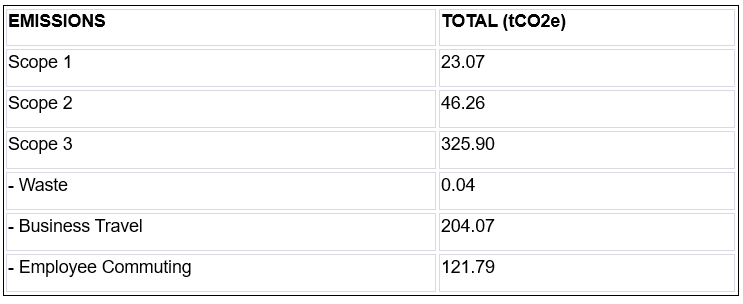
Reporting Year: 2026
Note: Upstream and Downstream Transportation & Distribution remain not relevant.
Total Emissions: 395.23 tCO2e
Emissions Reduction Targets
FORWARD COMMUNITY CARE LTD has established following emissions reduction targets to guide our journey to Net Zero by 2050:
Total Emissions: 275.25 tCO2e
Emissions Reduction Targets
FORWARD COMMUNITY CARE LTD has established the following emissions reduction targets to guide our journey to Net Zero:
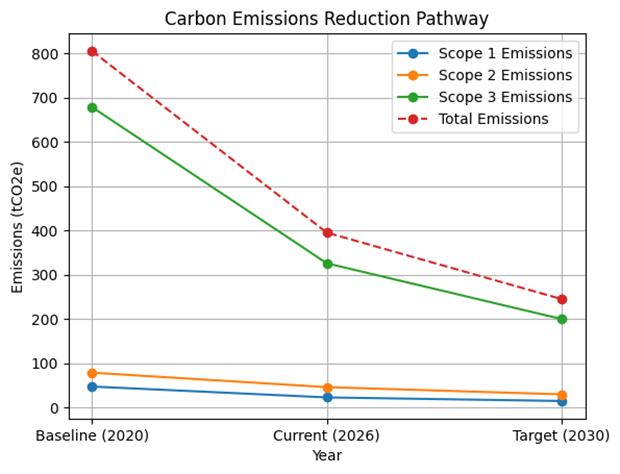
Reduce Scope 1 emissions by 65.2% by 2030.
Reduce Scope 2 emissions by 46.2% by 2030.
Engage with suppliers to reduce Scope 3 emissions by 62.2% by 2030.
These targets align with our commitment to sustainability and our goal of significantly reducing our carbon footprint by 2035.
Progress against these targets can be visualised in the accompanying graph, which compares projected reductions against actual year-on-year emissions
Ongoing and Planned Carbon Reduction Projects
FORWARD COMMUNITY CARE LTD is dedicatedly advancing towards its Net Zero emissions goal with several ongoing and planned projects:
Retrofitting older structures with green roofing, energy-efficient windows, and improved insulation to reduce energy use.
Looking into off-site renewable energy investments and on-site wind energy solutions to complete the switch to renewable energy sources.
Developing a plan to offset carbon emissions by funding community emission reduction initiatives, renewable energy sources, and forestry.
Encouraging flexible work schedules and telecommuting with the goal of reducing emissions associated with commuting by 20%.
Putting into practice green IT initiatives, such as server virtualisation and ethical disposal of electronic waste.
Making R&D investments in goods and services to reduce carbon footprints for customers as well as for internal use.
Starting water-saving initiatives to tangentially lower carbon emissions.
Organising the start of a "green champions" programme to involve staff members in efforts to reduce carbon emissions.
By taking these steps, FORWARD COMMUNITY CARE LTD is promoting sustainable growth and innovation in the healthcare industry in addition to lessening its impact on the environment.
FORWARD COMMUNITY CARE LTD aims not just to reduce its environmental impact, but also to create long-term growth and innovation in our sector through these activities. We realise that our journey to Net Zero is ongoing, and we are committed to continued growth and the implementation of best environmental stewardship practices.
Declaration and Sign Off
This Carbon Reduction Plan has been completed in accordance with PPN 06/21 and associated guidance and reporting standard for Carbon Reduction Plans.
Emissions have been reported and recorded in accordance with the published reporting standard for Carbon Reduction Plans and the GHG Reporting Protocol corporate standard1 and uses the appropriate Government emission conversion factors for greenhouse gascompany reporting2.
Scope 1 and Scope 2 emissions have been reported in accordance with SECR requirements, and the required subset of Scope 3 emissions have been reported in accordance with the published reporting standard for Carbon Reduction Plans and the Corporate Value Chain (Scope 3) Standard.
This Carbon Reduction Plan has been reviewed and signed off by the relevant management body.
Reviewed by: Trisha Bonnar (Registered Manager)
Date: 21/03/2026